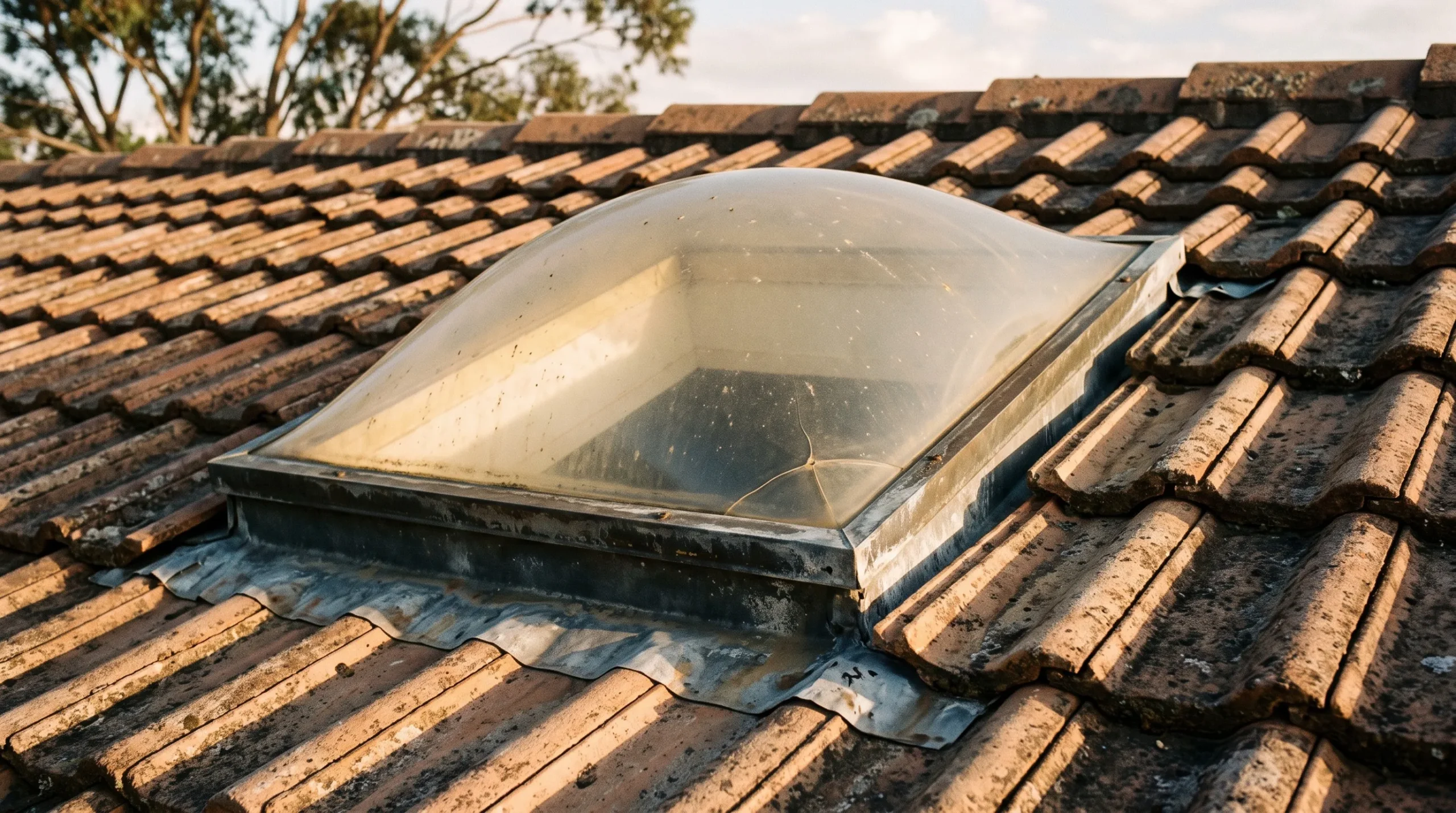
Skylight leaks on tile roofs are almost always a flashing problem, not a glass problem. In Tucson, a skylight that stays dry through months of sun can suddenly pour water during the first monsoon storm because UV and heat cycling have already degraded the flashing seal months earlier. Properly woven tile‑specific flashing prevents that, not extra sealant.
TL;DR
- On a tile roof, a skylight’s watertightness depends on how the flashing is woven into the tile courses, not on sealant alone.
- Most skylight leaks appear right after the first monsoon storm because UV exposure and heat cycling have silently broken down the flashing bond over the summer.
- When a skylight leaks, the culprit is usually repairable flashing or dried‑out sealant; replacement is only necessary when the dome is cracked or the frame has failed.
- For bathrooms, closets, and hallways, a solar tube delivers daylight through a much smaller roof penetration, reducing leak risk and installation complexity.
- A correct new installation on a tile roof includes a raised curb, tile‑specific flashing integrated with the underlayment, and careful tile resetting to keep water flowing away from the opening.
Can You Put a Skylight on a Tile Roof? Yes, but the Flashing Has to Be Different
Yes, tile roofs fully support skylights, but only when tile‑specific flashing and integration details are used. Generic curb‑mounted kits designed for asphalt shingles will fail because they cannot follow the contours of tile or redirect water across the stepped surface. The
International Building Code requires roof penetrations to be flashed in a way that prevents water from entering, and on a tile roof that means the flashing must be compatible with the tile profile. Standard shingle flashing pieces cannot tuck under lifted tiles or overlap the next course correctly, so a dedicated tile‑skylight kit with a raised curb and flexible step flashing is the only reliable option. For a
skylight installation on tile roofs in Southern Arizona, the system starts with assessing the tile layout and underlayment before any cutting begins.
How Skylight Flashing Weaves Into Tile Roof Courses
The flashing system begins with a head flashing that slips under the tile course above, combined with step flashing along the sides and a back pan that directs water onto the tile course below. On a tile roof, the upper edge of the head flashing is tucked beneath the underlayment and the first course of tile so that water running down the roof never meets the top of the skylight curb.
VELUX installation guidance shows that step‑flashing pieces interlock with each tile as it is laid, creating a shingled drainage path that sheds water around the opening. The back pan, or saddle flashing, sits at the high side of the curb and diverts water to either side, then onto the tiles below. If the flashing isn’t woven this way, water will find the gap between the tile and the curb. When underlayment or surrounding tiles are compromised, our team can provide tile roof repair to restore a sound base for the flashing work.
Why a Skylight That Doesn’t Leak All Summer Can Suddenly Pour Water During Monsoon Season
UV exposure and the extreme heat cycling of Tucson summers cause sealants and even metal flashing to expand, contract, and gradually lose adhesion; by August, the bond is weak, and a monsoon storm simply finds the path of least resistance. The Arizona State Climate Office records show that Southern Arizona’s intense sun and daytime rooftop temperatures routinely exceed 150°F, while sudden monsoon downpours drop the surface temperature by 50 degrees or more in minutes. This repeated thermal shock, documented in Energy Star skylight performance notes, accelerates sealant aging and breaks the adhesion between flashing and tile, even if the skylight looked fine during the dry months. By the time the first monsoon rain arrives, the flashing may already be separated enough to let water in, which is why we get most of our skylight repair in Tucson calls right after that first big storm. Catching the degradation during a pre‑monsoon inspection prevents the panic, and our team offers seal, flashing, and glazing repair on tile and shingle roofs to get ahead of monsoon season.
Skylight Leak Repair vs. Replacement: When the Flashing Is the Real Culprit
Most leaking skylights do not require a full replacement; if the leak traces back to failed flashing or dried‑out sealant and the dome and frame are sound, a targeted repair restores watertightness. Replacement becomes necessary only when the acrylic dome is cracked, the frame is warped, or the thermal seal between glass panes has failed, letting condensation build inside the unit. CertainTeed skylight resources explain that flashing and sealant are wear items designed to be renewed, while the curb and glazing unit can last decades. A thorough leak investigation traces the water path from the interior stain up to the roof; if the water is entering around the curb, a skylight repair in Tucson that re‑flashes the opening and re‑applies exterior sealant solves the problem without replacing the dome. When the dome itself is damaged, a complete unit swap, handled as part of our new skylight installation, makes more sense. The same principle applies to tile roofs specifically: you don’t tear out an entire skylight and curb just because the flashing weaves aged out.
Solar Tube vs. Skylight on a Tile Roof: Which One Makes Sense for Smaller Spaces
For closets, bathrooms, and hallways, a solar tube can bring in daylight with a much smaller roof penetration, reducing tile disturbance and leak potential. The table below compares a full skylight and a solar tube on a tile roof so you can choose the right daylighting option.
| Feature |
Full Skylight |
Solar Tube |
| Roof penetration size |
Typically 2 ft x 4 ft or larger |
10 to 14 inch diameter |
| Installation complexity on tile |
Several tiles must be lifted and cut; flashing must be woven into multiple courses |
One or two tiles lifted; small dedicated tile flashing kit |
| Light output |
Broad daylight to a whole room, some heat gain |
Focused daylight suitable for a small space, minimal heat gain |
| Ideal room |
Living rooms, kitchens, open areas |
Closets, bathrooms, hallways, laundry rooms |
| Typical cost range |
Higher due to larger opening, framing, and flashing work |
Lower overall because of smaller penetration and simpler installation |
| Maintenance |
Dome cleaning, flashing inspection twice a year |
Dome cleaning, seal check, flexible tube stays sealed |
Sources: U.S. Department of Energy daylighting guide, Solatube product information, and VELUX comparison resources. For either option, a skylight installation on a tile roof must use tile‑compatible flashing to stay watertight.
What a Proper New Skylight Installation on a Tile Roof Should Include
A correct installation starts long before the first tile is lifted. Our team begins by inspecting the underlayment and the condition of the tiles around the planned opening, because a skylight only keeps water out if the roofing base below it is intact. Once the location is marked to match the manufacturer’s curb dimensions, we cut the roof deck and frame the opening. The key step is installing a raised curb with an integrated tile flashing kit, per VELUX installation instructions, so that the head flashing slides under the upper tile course and the step flashing interlocks with each side tile as it is reset. The back pan or saddle flashing diverts water around the high side of the curb, directing it onto the tile course below. After the flashing is woven, we verify that water flowing from the upper roof plane drains around the skylight without pooling, then apply a high‑quality exterior sealant rated for desert UV exposure. Cutting corners on any of these steps, especially skipping the tile‑specific flashing in favor of generic shingle pieces, is the number‑one cause of monsoon leaks. The International Building Code requires roof penetrations to be flashed and made weatherproof, and a Tucson tile roof demands local experience to meet that standard. Every new installation we complete follows this sequence, because a skylight should bring in daylight, not a call for emergency repairs.
Frequently asked questions
Can a solar tube be installed on a tile roof just like a skylight?
Yes, a tubular daylighting device, often called a solar tube, uses a smaller flashing kit designed specifically for tile. The roof penetration is only 10 to 14 inches in diameter, so just one or two tiles are lifted rather than a large section. As long as the flashing is tucked under the tile course above and sealed properly, it integrates with a tile roof the same way a full skylight curb does.
How often should skylight flashing be inspected on a Tucson tile roof?
At least twice a year, once before monsoon season (May or June) and once after (September or October). The pre‑monsoon inspection catches any flashing that has lifted or sealant that has baked out during the dry heat, and the post‑monsoon check confirms nothing shifted during heavy storms. This two‑visit rhythm matches Tucson’s two‑season inspection calendar we recommend for all roof maintenance.
What is the typical lifespan of a skylight installed on a tile roof?
With high‑quality tile‑compatible flashing and regular maintenance, a skylight can last 20 to 30 years before the frame or seals need replacement. The acrylic dome itself may yellow or become brittle earlier under intense desert sun, but that can often be swapped without replacing the entire curb and flashing. Resealing the flashing can be done multiple times over the unit’s life to keep water out.
Will repairing a skylight leak on a tile roof require tearing off tiles?
Not necessarily. Experienced roofers can gently lift a few surrounding tiles, replace or reseal the flashing beneath, and reset the tiles without large‑scale removal. If the underlayment below the skylight is damaged by a long‑standing leak, a larger tile‑off section may be needed, but that is less common when leaks are caught early.
Is condensation on a skylight the same as a roof leak?
No. Condensation forms on the interior of the dome when warm, humid indoor air hits the cooler glass surface, especially in bathrooms and kitchens. It does not indicate a flashing failure or water intrusion from outside. Improving ventilation or choosing a skylight with a thermal break reduces condensation, but it is a separate issue from a leaking flashing seal.