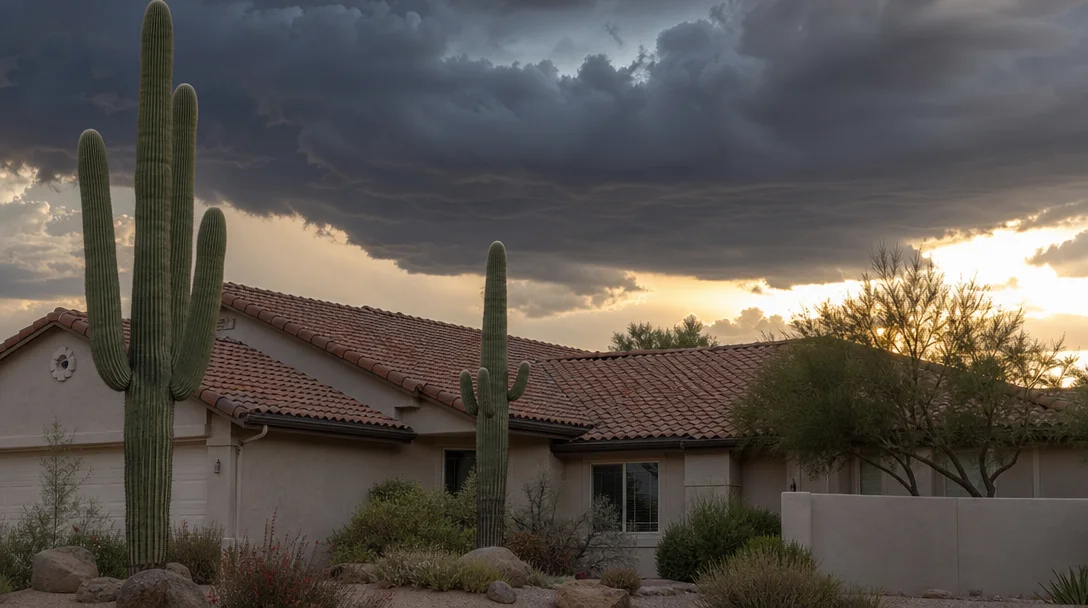
A crooked roof tile the morning after a monsoon storm is easy to shrug off, especially when the ceiling underneath is dry. But a lifted tile is often the start of a leak, not the end of the storm's damage. Here's why the gap between one storm and the next matters so much on a Southern Arizona tile roof.
One Storm Doesn't Prove Your Roof Is Fine
Here's the thing most people get wrong about tile. The tile isn't waterproofing your house. It's armor. Underneath it sits the underlayment, a felt or synthetic membrane that stops water from reaching the decking.
So when a storm lifts or slides a tile, nothing leaks right away. The underlayment is still doing its job. You walk outside the next morning, see a crooked tile, look at your dry ceiling, and figure the roof handled it fine.
But the exposed spot is now on a clock, and a dry ceiling is a poor test. Water that gets past a gap doesn't drop straight down. It runs sideways along the decking and framing and can show up somewhere else entirely, sometimes weeks later.
Water can sit in attic insulation for days before it stains drywall.
One short burst of rain may not soak all the way through, but back-to-back storms can.
Wind direction changes from storm to storm, so a gap that stayed dry in June can catch driving rain in August.
Sun and heat weaken exposed underlayment a little more every week it sits uncovered.
A tile that shifted once is often sitting on loose or broken fasteners, which means its neighbors may be ready to move too.
That last point matters more than the rest. A lifted tile is rarely a one-off accident. It's usually a symptom of cracked mortar at the ridge, worn fasteners, or underlayment that has already lost its grip.
Repeat chances are what make monsoon season hard on a weak spot. Arizona's monsoon season officially runs June 15 through September 30, and the National Weather Service reports that thunderstorm wind gusts in Arizona almost always exceed 40 mph. That's a lot of wind and driving rain hitting the same roof from changing angles, and one clean pass says nothing about the next one.
A useful way to think about it: the tile moving is the warning, and the leak is the consequence. Those two events can be months apart, and the space between them is your window to fix a small problem before it becomes a wet-insulation problem.
For a look at how a post-storm inspection and repair work in practice, David Contreras of DC Roofing of Arizona, who has been roofing in Tucson since 2011, explains it on this page about storm damage roof repair in Vail.
How a Lifted Tile Leads to an Indoor Leak
The tile takes the hit from sun, wind, and flying palo verde branches. The underlayment beneath it does the real waterproofing. When a tile lifts or slides, that membrane loses its shade and its shield, and in Arizona losing shade is the whole problem.
Picture a tile on the back slope, facing away from the street, that slides a few inches in a July storm. Nobody notices. Here's how that one small shift can end up as a stain over the kitchen:
Wind lifts or shifts the tile, exposing a patch of underlayment to direct sun.
UV and intense summer roof heat break that exposed patch down far faster than they would under tile.
Swings between hot days and cooler nights work the weakened spot open and crack it.
Debris from the same storm packs into the gap and holds moisture against the membrane.
The next rain finds the crack and soaks into the decking underneath.
The water travels along rafters or sheathing until it finds a low point, often feet from the original tile.
It finally appears on a ceiling as a stain that seems to come from nowhere.
That's why so many people misjudge where a leak started. Water doesn't fall straight down. It runs sideways along framing, then drops, so a stain in the living room can trace back to a shifted tile above the garage.
How long can exposed underlayment last? There's no single number. Every underlayment product comes with a manufacturer-stated limit on how long it can sit in direct sun, because none of them are designed to stay uncovered for good. Arizona heat and UV use up that allowance quickly, so an exposed spot deserves attention sooner rather than later.
There's a second path too. A lifted tile breaks the water-shedding pattern of the tiles around it. Rain that should flow tile over tile down the slope can spill sideways into the course below, concentrating water into one narrow channel right where the membrane is already weakened.
One storm creates the opening. Sun does the slow damage. The next storm collects the bill.
Why the Damage Gets Worse With Each Storm, Not Better
A lifted tile doesn't sit still, and the problem rarely stays the size it started. Once one tile is out of place, the tiles around it lose support and overlap. Wind gets under the edge of the next one. A single lifted tile in July can turn into a small bare patch by September, and at that point you're dealing with a section, not a tile.
Several things in the Sonoran Desert speed that up:
Blowing debris. Palo verde limbs and mesquite branches scrape exposed underlayment and can tear it.
Grit and sand that wash into the gap and hold moisture against the decking.
Foot traffic. Tile cracks easily underfoot, so a well-meaning walk across the roof can add damage.
Older underlayment on older homes that is already near the end of its life.
Valleys and flashing lines, where a single gap can funnel a lot of water to one spot.
Most people don't see any of this until the first ceiling stain appears. By then the repair isn't just a tile. It can involve underlayment, sometimes decking, and sometimes drywall and insulation too.
The flip side is good news. Caught between storms, a lifted tile is usually a small, straightforward repair: reset the tile, patch or replace the underlayment beneath it, and check the surrounding tiles for cracks and loose fasteners. The window between one monsoon storm and the next is the cheap-fix window, and it closes quietly.
Frequently Asked Questions
How do I know if a lifted tile means I need a professional or if I can fix it myself?
Call a professional once a tile has visibly shifted, cracked, or slid out of place. Walking a tile roof yourself can crack more tiles and cause more damage than the storm did. Tile roofs also hide broken fasteners and weakened underlayment that aren't visible from the ground, and a trained eye can spot which tiles are at risk of moving next. If a monsoon storm moved even one tile, it's worth having someone check the whole slope, not just that spot.
What's the biggest misconception homeowners have about tile roofs after a storm?
Most people think the tile itself keeps water out of the house. It doesn't. The tile is armor that protects the underlayment, and the underlayment does the actual waterproofing. When a tile shifts, homeowners check for a wet ceiling and assume everything is fine if it's dry. But the real damage happens slowly, as sun and heat break down the exposed underlayment over the following weeks.
Why does Arizona's monsoon season make this problem worse than in other climates?
Monsoon season officially runs from June 15 through September 30, so a weak spot faces repeated storms, and wind can come from a different direction each time. A gap that stayed dry during one storm can catch driving rain in the next. In between, intense sun and heat bake exposed underlayment until it turns brittle and cracks. That combination is why one lifted tile rarely stays a small problem for long.
Why did my roof stay dry after the storm but leak weeks later?
Water doesn't drip straight down once it gets past a lifted tile. It runs sideways along the decking and rafters before finding a low spot, so a stain can show up far from where the tile moved. A single storm often isn't enough to soak all the way through, but back-to-back monsoon storms can be. That delay is why many homeowners don't notice trouble until well after the tile first shifted.
How long can exposed underlayment survive in Arizona sun before it fails?
There's no single answer, because each underlayment product has its own manufacturer-stated limit for sun exposure, and none are meant to stay uncovered permanently. Arizona heat and UV use up that limit faster. Once a tile lifts, the underlayment loses its shade and starts breaking down. Treat an exposed spot as something to fix promptly rather than a wait-and-see item.
Does one shifted tile usually mean other tiles are at risk too?
Often, yes. A single lifted tile usually means the fasteners holding it were already loose or broken, and nearby tiles may be sitting the same way. Cracked mortar at the ridge or underlayment that has lost its grip can affect a whole section of roof. That's why checking the surrounding tiles matters more than fixing only the one you can see.
For additional information, contact:
DC Roofing of Arizona
227 E Valencia Rd Unit YD3, Tucson, AZ 85706